The Dietary Guidelines: Why Science, Not Politics, Should Guide What We Eat
Michael J Donovan, PhD
1/8/20269 min read
Every five years, the United States government releases updated Dietary Guidelines for Americans. These guidelines shape what millions of children eat in school cafeterias, what our military service members are served, and what foods appear in federal nutrition programs. They influence the advice your doctor gives you and the products lining grocery store shelves. In short, these guidelines have enormous power over the health of every American.
Here's the problem: the process that should be driven purely by science and public health has become increasingly politicized. Since 2020, we've witnessed a troubling erosion of the boundary between scientific expertise and political ideology across many areas of public health. The dietary guidelines have not escaped this trend. Understanding how politics has infiltrated this critical process is essential for every American who cares about making informed choices about their health.
A Brief History: How the Guidelines Were Meant to Work
The story of federal dietary guidance stretches back more than a century. The government has been offering nutrition advice since the early 1900s, but the modern Dietary Guidelines for Americans began in 1980. Back then, the first edition sparked controversy when it suggested connections between diet and health that some felt weren't fully supported by available science. Industry groups and scientists questioned whether the evidence was strong enough.
To address these concerns, Congress mandated in 1983 that an advisory committee of independent scientific experts should review the evidence and make recommendations. This was supposed to create a firewall between political interests and scientific truth. The committee, known as the Dietary Guidelines Advisory Committee, would be composed of nutrition and medical experts who would spend years reviewing thousands of studies, then submit a scientific report. Only after this rigorous scientific review would government officials write the actual guidelines.
The process was designed with transparency in mind. Committee members must disclose financial conflicts of interest. Public comment periods allow citizens and organizations to weigh in. The goal was clear: create dietary recommendations based on the best available science, free from political pressure and corporate influence. For decades, this system worked reasonably well, even if imperfectly. But recent years have revealed significant cracks in the foundation.
The COVID-19 Watershed: When Public Health Became Political
To understand what's happened to the dietary guidelines, we need to look at the broader context of how public health became politicized during the COVID-19 pandemic. The pandemic created what researchers have called "a perfect storm" for eroding trust in science. During COVID-19, we watched scientific uncertainty play out in real time on our screens. Early recommendations about masks changed as scientists learned more about how the virus spread. Projections about infection rates and deaths sometimes proved inaccurate. This is how science works—it evolves as new evidence emerges. But for millions of Americans, these changes looked like scientists didn't know what they were doing or were hiding something.
Political leaders sidelined, ignored, or misrepresented scientific findings on countless occasions. What should have been straightforward public health measures—wearing masks, social distancing, getting vaccinated—became tests of political loyalty. By November 2020, 84 percent of Democrats viewed COVID-19 as a major public health threat, compared with only 43 percent of Republicans. Americans couldn't even agree that a pandemic killing hundreds of thousands was a serious problem.
The consequences have been lasting. Research shows that confidence in doctors and hospitals dropped from about 70 percent at the start of the pandemic to just over 40 percent by 2025. Trust in scientific institutions generally has declined, with many questioning whether federal health agencies can operate independently from political influence. This erosion of trust didn't happen in a vacuum. It was fueled by misinformation spreading rapidly across social media, mixed messaging from leaders, and, critically, the weaponization of scientific uncertainty for political gain. When science becomes just another political football, everyone loses—especially public health.
The Same Pattern: Politics Infiltrating Nutrition Science
The dietary guidelines process has followed a disturbingly similar trajectory. Just as COVID-19 science became politicized, nutrition science is increasingly caught in the political crossfire.
Industry Influence: Following the Money
One of the most significant ways politics enters the guidelines is through industry influence. A 2022 study published in Public Health Nutrition examined the conflicts of interest among members of the 2020 Dietary Guidelines Advisory Committee. The findings were striking: researchers documented more than 700 industry connections among the 20 committee members. Ninety-five percent of committee members had conflicts of interest with food and pharmaceutical industries. The connections involved major food corporations including Kellogg, Abbott, Kraft, General Mills, and Dannon. These weren't just casual relationships—they included research funding, advisory board positions, and consulting arrangements. One committee member alone accounted for 152 documented industry ties.
To be clear, not all relationships with industry are automatically problematic. Many nutrition researchers receive funding from food companies, and this doesn't necessarily mean their research is biased. However, the concern is about transparency and accumulation of influence. The National Academies of Sciences recommended in 2017 that all financial and nonfinancial conflicts should be publicly disclosed. Yet researchers found that these disclosures were never posted on the official Dietary Guidelines website as promised. This lack of transparency undermines public trust. When people learn that committee members have extensive ties to the very industries whose products will be affected by the guidelines, they naturally wonder: whose interests are really being served?
Debates Becoming Battlegrounds
Specific dietary recommendations have become political battlegrounds, often divorced from scientific evidence. Consider some recent controversies:
Ultra-processed foods: There's growing scientific evidence linking ultra-processed foods to obesity, diabetes, and other chronic diseases. Yet addressing this in guidelines touches powerful economic interests. Food manufacturers have fought hard against regulations that might affect their bottom lines.
Red meat and dairy: Recommendations about limiting red meat consumption or choosing low-fat dairy have sparked fierce debates. Agricultural industry groups have lobbied intensively to ensure favorable treatment. Meanwhile, environmental scientists note that meat production has significant climate impacts—but bringing environmental concerns into dietary guidelines has itself become political.
Plant-based versus animal-based diets: What should be a scientific discussion about nutritional adequacy has become entangled with cultural identity politics. Eating meat or avoiding it has become a marker of political affiliation in some circles.
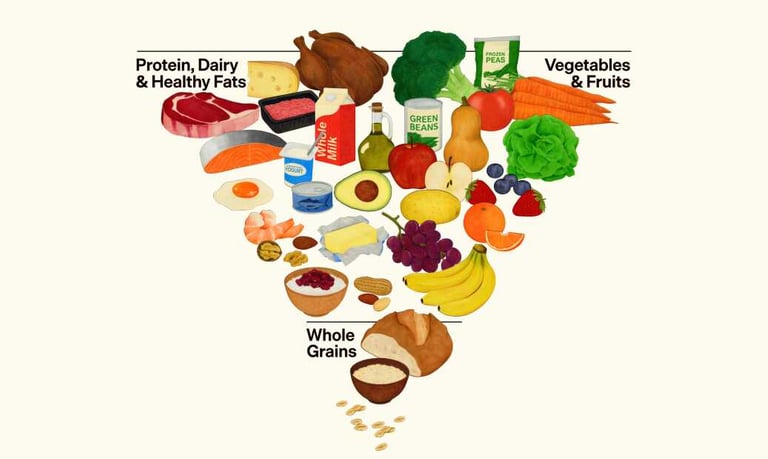
The 2025-2030 guidelines, released just recently, exemplify these tensions. The new guidelines emphasize higher protein intake, favor full-fat dairy, and even mention beef tallow as a cooking fat option—recommendations that some nutrition experts have questioned. Meanwhile, political leaders have framed the guidelines in explicitly ideological terms, with statements about rejecting "leftist ideologies" and restoring "scientific integrity," language that ironically politicizes what should be a scientific process.
Social Media: Amplifying Misinformation
If industry influence provides one avenue for politics to infiltrate nutrition science, social media provides another—and arguably more insidious—route. Research examining nutrition content on platforms like TikTok and Instagram reveals an alarming landscape. Studies found that 82 percent of nutrition posts lacked transparent advertising, 77 percent failed to disclose conflicts of interest, and 55 percent did not provide evidence-based information. More troubling still, completely inaccurate posts often received more engagement than accurate ones.
Social media algorithms prioritize virality over accuracy. Sensational claims like "carnivore diet cures autoimmune disease" or "seed oils are toxic" spread rapidly, regardless of scientific merit. Influencers with no nutrition training amass millions of followers and shape public perceptions more effectively than researchers publishing peer-reviewed studies. This creates a vicious cycle. When official dietary guidelines contradict what people have absorbed from influencers, they're more likely to trust the influencer. After all, that person seems authentic, relatable, and isn't part of "the establishment." The scientific community struggles to compete in an attention economy designed to reward emotional engagement over factual accuracy. The COVID-19 pandemic turbocharged this dynamic. Nutrition misinformation piggybacked on broader distrust of public health institutions. If you believed government officials lied about COVID-19, why would you trust them about what to eat?
Why This Matters: The Real-World Impact
Some might shrug and say, "Does it really matter if dietary guidelines are a bit political? Can't people just decide for themselves what to eat?" It matters enormously, for several reasons:
Federal programs feed millions: The dietary guidelines directly shape what's served in school lunch programs, feeding approximately 30 million children daily. They guide meals for military personnel, veterans' facilities, and federal food assistance programs like WIC (Women, Infants, and Children). When politics rather than science drives these decisions, the health consequences affect our most vulnerable populations.
Doctors rely on them: Healthcare providers base their nutrition counseling on these guidelines. If the guidelines are compromised by political or industry influence, doctors may be recommending diets that don't reflect the best scientific evidence.
They shape food industry practices: Manufacturers reformulate products and adjust marketing based on the guidelines. Food labels, health claims, and product development all flow from these recommendations.
Public health outcomes: Poor diet is the leading preventable risk factor for chronic disease in America. Heart disease, diabetes, obesity, and certain cancers are all strongly linked to dietary patterns. Getting nutrition guidance wrong doesn't just mean bad advice—it means preventable illness, suffering, and death on a massive scale.
Trust in institutions: Perhaps most importantly, politicizing the guidelines erodes public trust in scientific institutions at a moment when we desperately need that trust. The next public health crisis—whether another pandemic, environmental disaster, or other emergency—will require public cooperation based on faith in expert guidance. Every time science is subordinated to politics, that trust erodes further.
What a Science-Based Process Should Look Like
So what would a genuinely science-based dietary guidelines process look like? How do we protect public health nutrition from political interference?
Truly independent expert committees: Committee members should be chosen based on scientific expertise, not ideological alignment. While complete independence from industry is probably impossible in nutrition research, strict limits on conflicts of interest should be enforced. The Institute of Medicine has recommended that no more than a minority of expert panels should have conflicts of interest.
Radical transparency: All conflicts of interest should be publicly disclosed and easily accessible. The public should be able to see exactly what relationships committee members have with industry, how those relationships might influence recommendations, and how those concerns are managed.
Insulation from political pressure: The committee's scientific report should be released publicly before government agencies begin drafting the actual guidelines. This creates accountability—if the final guidelines deviate from the committee's scientific conclusions, the public can see it and demand explanations.
Longer timelines: The current five-year cycle creates pressure to rush the process. Extending the timeline would allow for more thorough review and reduce the impact of political turnover.
Better science communication: Scientific institutions need to get better at communicating uncertainty without undermining confidence. The public needs to understand that science evolves and that changing recommendations in light of new evidence isn't weakness—it's how science should work.
Combating misinformation: Social media platforms should verify credentials of people providing nutrition advice and implement measures to promote accurate information over viral sensationalism. Media literacy education should help people identify reliable sources.
Moving Forward: Reclaiming Science from Politics
The politicization of public health and nutrition science isn't inevitable, but reversing it requires deliberate effort from multiple directions.
For individuals: Be skeptical of nutrition advice that sounds too good to be true or that demonizes entire food groups. Check sources—does the person have actual training in nutrition? Are they selling something? Follow registered dietitians and nutrition scientists, not just influencers with great bodies and compelling stories.
For scientists: Engage more actively with the public. The scientific community can't afford to stay in the ivory tower, publishing papers for each other while misinformation runs rampant. Scientists need to learn to communicate on platforms where people actually get information, making evidence-based advice engaging and accessible.
For policymakers: Recognize that protecting the integrity of scientific processes isn't partisan—it serves everyone's interests. Resist the temptation to override expert recommendations for political gain. Support funding for nutrition research that isn't industry-sponsored.
For media: Do better. Stop giving equal weight to fringe positions and mainstream science. Stop writing headlines that oversimplify or sensationalize research findings. Help your audience distinguish between a single preliminary study and the scientific consensus built from hundreds of studies.
For institutions: Rebuild trust through transparency, accountability, and consistent adherence to scientific principles. When you make mistakes, own them. Explain your reasoning. Show your work. Trust isn't granted—it's earned through demonstrated integrity over time.
Conclusion: Our Health Depends on It
The dietary guidelines matter because nutrition matters. What we eat shapes our health in profound ways. Children growing up on diets high in ultra-processed foods face increased risks of obesity, diabetes, and other chronic diseases that will affect them for life. Adults following poor dietary patterns are more likely to suffer heart attacks, strokes, and premature death. Getting nutrition science right is literally a matter of life and death, multiplied across millions of people. We can't afford to let political ideology, industry profits, or social media virality drive decisions that should be based on careful evaluation of scientific evidence.
The COVID-19 pandemic showed us the dangers of politicizing public health. We watched in real time as partisan divisions over masks, vaccines, and other measures cost lives. The same dynamics now threaten nutrition guidance, with potentially devastating long-term consequences, but it doesn't have to be this way. Science has a proven track record of improving human health when allowed to function properly. The dramatic increases in life expectancy over the past century owe much to scientific advances in medicine, sanitation, and yes, nutrition. We know more about the relationship between diet and health than ever before.
The question is whether we'll let that knowledge guide policy, or whether we'll allow politics, profits, and misinformation to override evidence. The dietary guidelines should be a triumph of science in service of public health. Making them so again requires vigilance, advocacy, and commitment from all of us. Your health, your children's health, and the health of the nation depend on keeping science in the center and politics on the sidelines where it belongs.
The next time you see a headline about dietary guidelines or nutrition research, ask yourself:
Who benefits from this message?
Is it based on the full body of scientific evidence or cherry-picked to support a predetermined conclusion?
Is this science or is this politics?
The answers matter more than you might think.