Capacity Over Longevity
Why Training for Performance, Not Disease Avoidance, Is a Superior Framework for Healthspan
Dr. Michael Donovan
4/9/202615 min read
Prologue: The Man on the Mountain
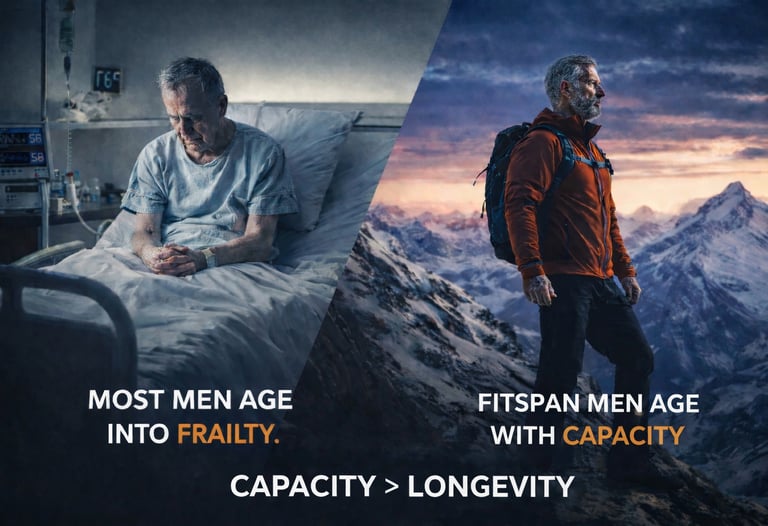
He was 52 years old when he called me. Not because he was sick. Not because his doctor had told him to. He called because he had just watched his 11-year-old daughter ski down a black diamond run — effortlessly, joyfully, the way children move when they have not yet learned to fear their own bodies — and he had stood at the top of that run, looked down, and chosen not to follow her.
He was not injured. He was not unfit by any conventional measure. He exercised. He maintained a reasonable weight. His annual physical came back clean. By every standard metric available to modern medicine, he was a healthy man, but standing at the top of that mountain, watching his daughter disappear into the tree line below, he felt something that no cholesterol panel had ever captured and no risk calculator had ever predicted: the first, cold awareness that his body was becoming a limit rather than a resource. That the gap between what he wanted to do and what he was willing to attempt was quietly, invisibly widening.
He did not need a longevity protocol. He did not need to be told that his VO₂ max correlated with all-cause mortality quintiles, or that his grip strength placed him in the third percentile for his age cohort, or that insulin resistance was silently remodeling his metabolic architecture. He needed something more fundamental than data. He needed a reason — a framework — that made the hard work of becoming more capable feel like something worth doing, not something to be feared into.
This paper is written for him. And for the thousands of men and women like him who exist at the intersection of high performance and quiet physical drift — who are accomplished, motivated, and capable in every domain of their lives except the one that will ultimately determine the quality of everything else.
The question is not how long you will live. The question is what you will be capable of doing with the years you have.
The FitSpan Doctrine begins there.
1. Introduction: The Longevity Movement and Its Limits
In the span of roughly a decade, longevity medicine has moved from the fringe of clinical practice to its leading edge. The work of researchers at the National Institute on Aging, combined with mechanistic discoveries in mTOR signaling, mitochondrial dynamics, and cellular senescence, has produced a scientific foundation sophisticated enough to support a genuine clinical discipline. The popular literature has followed: from David Sinclair's Lifespan to Andrew Huberman's science communication work to Peter Attia's Outlive, the central thesis has achieved broad cultural penetration — your biology is not destiny, your lifestyle choices interact with your aging trajectory in measurable and modifiable ways, and the time to intervene is now.
This is progress. The transformation of aging from an inevitable biological sentence into a domain of active management represents one of the more consequential shifts in modern preventive medicine.
The question this paper addresses is not whether the longevity movement is right in its targets. It largely is. The question is whether it is right in its framework — its motivational architecture, its epistemological consistency, and its practical operationalization for the specific population most likely to act on it: high-performing adults in midlife who have the resources, the intelligence, and the behavioral capability to build something extraordinary with their second half of life, if given a reason that resonates with who they actually are.
We will argue that the dominant longevity framework falls short on all three dimensions — and that a performance-centered alternative produces superior outcomes not in spite of its different framing, but because of it.
Who This Is For
The FitSpan framework is designed for a specific population: adults between 40 and 60 who are currently functional and relatively healthy, who are high performers in their professional and personal lives, and who are experiencing — or beginning to experience — the gradual divergence between physical aspiration and physical capability that characterizes early functional decline.
This population is not the primary target of the longevity medicine literature, which skews toward individuals who are already metabolically compromised or managing early chronic disease. The distinction matters enormously. The behavioral economics of health motivation differ dramatically between a 58-year-old with a recent Type 2 diabetes diagnosis — for whom threat salience is immediate — and a 47-year-old executive whose bloodwork is clean but who cannot keep up with his children on a hiking trail. The former may respond well to a fear-based framework. The latter requires something else entirely.
2. The Epistemological Problem: A Double Standard in Evidence
Attia's Critique of Nutritional Epidemiology
Among the most intellectually sophisticated passages in Outlive is Attia's sustained critique of nutritional epidemiology. He correctly identifies its structural weaknesses: reliance on self-reported food frequency questionnaires with well-documented recall bias; the near-impossibility of controlling for confounding variables in free-living populations; the conflation of association with causation in both primary literature and popular reporting; and the absence of long-duration randomized controlled trials for most dietary intervention hypotheses.
These are legitimate concerns. The PREDIMED trial, widely cited as evidence for the Mediterranean diet's cardiovascular benefits, was retracted and corrected following a randomization integrity controversy. The Seven Countries Study, which anchored decades of saturated fat policy, has been extensively criticized for selective country inclusion. Attia's skepticism is, in these cases, epistemically warranted.
The Inconsistency
The problem emerges when we examine the evidentiary basis for Attia's own exercise prescription claims against the same methodological standard.
The cornerstone of the Attia exercise framework is VO₂ max as the premier longevity predictor. The primary citation is Mandsager et al. (2018), a retrospective cohort study of 122,007 patients at the Cleveland Clinic, which found that low cardiorespiratory fitness was associated with higher all-cause mortality than hypertension, diabetes, smoking, and end-stage renal disease combined. This is a remarkable finding. It is also an observational study — the same study design Attia categorizes as insufficient to establish causation in the nutritional context.
The grip strength data he cites (the PURE study — a prospective cohort of 140,000 adults across 17 countries) is similarly observational. The zone 2 training recommendations, while grounded in compelling mechanistic data on mitochondrial biogenesis, lack the RCT evidence base that Attia demands of dietary interventions. The Centenarian Decathlon framework is built on inference and extrapolation from cross-sectional aging data, not prospective intervention trials.
The issue is not that observational evidence is worthless — it is not. The issue is the inconsistency. Attia dismisses epidemiological nutrition studies for methodological limitations that apply with equal force to the epidemiological exercise studies he elevates. A reader walking away from Outlive could reasonably conclude that epidemiological evidence is unreliable in nutrition but reliable in exercise physiology — a conclusion not supported by any principled methodological distinction between the two domains.
The practical prescriptions in Outlive may well be correct. The confidence with which they are presented does not accurately reflect the state of the science.
3. The Motivational Architecture Problem
Fear as a Health Motivator: What the Research Says
Outlive is, at its psychological core, a fear-based document. This is not a pejorative characterization — it is a structural observation. The book's central motivational logic is: here are the diseases that will kill or disable you; here is the timeline on which they are developing silently in your body right now; here is the training prescription that gives you the best chance of avoiding them. The emotional register is threat, urgency, and loss prevention.
Protection motivation theory provides the framework for this approach. It holds that health behavior change is motivated by the combination of threat appraisal — how serious is this, and how vulnerable am I — and coping appraisal — will this intervention work, and can I do it. When both are high, protection motivation theory predicts behavioral initiation.
The empirical record on this as a sustained behavioral motivator is considerably less impressive than its theoretical elegance suggests. Meta-analyses consistently find that fear appeals produce reliable short-term behavioral intentions but significantly weaker long-term behavioral enactment. For the kind of decades-long training commitment that actually produces meaningful health outcomes, fear is a poor engine.
Self-Determination Theory and Intrinsic Motivation
The most empirically robust framework for sustained health behavior change is self-determination theory (SDT), developed by Deci and Ryan at the University of Rochester and validated across hundreds of health behavior contexts. SDT distinguishes between externally regulated behavior — driven by external rewards, punishments, or threat — and autonomously regulated behavior — driven by intrinsic interest, values identification, or integrated personal meaning.
The key finding, replicated consistently across exercise, diet, medication adherence, and rehabilitation contexts, is that autonomous regulation predicts long-term behavioral maintenance while external regulation does not. Teixeira et al. (2012), in a systematic review of SDT in exercise contexts, found that autonomous motivation was positively associated with physical activity across all time horizons, with the effect size increasing with follow-up duration — the opposite pattern from fear-based interventions.
At the neural level, autonomous motivation activates mesolimbic dopaminergic pathways associated with intrinsic reward and behavioral persistence. Fear-based motivation activates amygdala-driven threat circuits that produce arousal and short-term behavioral mobilization but are poorly suited to maintaining complex behavioral routines over years. Training toward a goal you care about and training away from a threat you fear are genuinely different biological processes with different behavioral dynamics.
The Identity Dimension
A third psychological dimension that the longevity framework underweights is identity. Research on identity-based motivation demonstrates that behaviors aligned with a person's self-concept are more automatically enacted, more resistant to disruption, and more efficiently maintained than behaviors experienced as external impositions.
The practical implication is significant. A 49-year-old who trains because he identifies as an athlete — because physical capability is part of how he understands who he is — maintains that training through injury, through professional stress, through the accumulated friction of a busy life, in ways that a 49-year-old training to reduce his cardiovascular risk quintile does not. The former has a self-concept to protect. The latter has a threat to avoid, and when the threat recedes from immediate salience — as it inevitably does between annual physicals — the behavior recedes with it.
We do not train people to be less sick. We train them to become more capable. These are not the same goal, and the difference in motivational architecture produces measurably different behavioral outcomes.
The High-Performer Mismatch
High-performing adults in midlife — executives, entrepreneurs, professionals who have built careers and families around competence and achievement — have spent decades being motivated by goals, standards, and the pursuit of performance. Their behavioral psychology is approach-oriented by deep habit and identity formation. Asking them to reorganize their physical lives around the avoidance of future disease is asking them to adopt a motivational architecture fundamentally foreign to how they operate in every other domain.
The result, observed consistently in clinical practice, is a characteristic pattern: motivated initiation following a health scare; good early adherence while the threat is salient; gradual drift as it fades; eventual abandonment; and often a cycle of shame and reinitiation at the next scare. This is not a character failure. It is a motivational architecture failure.
4. The FitSpan Doctrine: Capacity as the Primary Target
Core Thesis
The FitSpan Doctrine rests on a single foundational claim: physical capacity is the primary variable, and longevity outcomes are its downstream consequence.
The longevity model holds that the goal of training is to reduce disease risk and extend functional lifespan. Capacity is a tool in service of that goal. The FitSpan model holds that the goal of training is to expand what you are capable of — the range of physical experiences available to you, the performance standards you can meet, the person you can be in your body. Longevity outcomes are a biological consequence of that development, not its aim.
You do not train for a long life. You train for a full one, and the biological systems you develop in pursuit of that fullness happen to be the same ones that extend and protect life.
Four Foundational Principles
Principle 1 — Capacity Precedes Longevity. The biological mechanisms through which exercise produces healthspan extension are identical to the mechanisms through which exercise produces athletic performance: mitochondrial biogenesis, cardiovascular adaptation, musculoskeletal integrity, metabolic flexibility, neuroendocrine regulation, and inflammatory modulation. You cannot engineer longevity outcomes without first building the capacity that produces them. The causal arrow runs from capacity to longevity.
Principle 2 — Performance Standards Are Motivationally Superior to Risk Thresholds. A man training toward a specific, personally meaningful physical standard — one that connects to something he wants to do, someone he wants to be, an experience he wants to have — generates a more durable, more identity-consistent behavioral commitment than a man training to move between risk quintiles on an epidemiological distribution. Both may be doing the same training. The one with the performance target will still be doing it in five years.
Principle 3 — Midlife Is Not the Beginning of Managed Decline. It Is the Window of Maximum Leverage. Trained adults in their late forties and fifties demonstrate mitochondrial densities, cardiovascular profiles, and metabolic architectures that rival — and in some cases exceed — those of sedentary adults twenty years younger. The fifth and sixth decades, for individuals who train with intention and intelligence, represent a period of genuine physiological capability development, not its terminus.
Principle 4 — The Body Is an Instrument, Not a Patient. The longevity framework implicitly positions the body as an aging system to be managed and protected from its own inevitable deterioration. The FitSpan framework positions it as an instrument — something to be developed, expressed, and expanded. People maintain instruments they are proud of. They neglect patients they have given up on.
5. The Five Pillars
The FitSpan Doctrine operationalizes through five physiological pillars, each grounded in peer-reviewed research, each carrying measurable performance targets and corresponding healthspan implications.
Pillar 1: Strength
Muscular strength and lean mass are among the most consistently replicated predictors of functional longevity and all-cause mortality. The PURE study — a prospective cohort of 140,000 adults in 17 countries — found that grip strength was a stronger predictor of cardiovascular mortality than systolic blood pressure. NHANES analysis demonstrated that the highest muscle mass tertile showed a 20% reduction in mortality risk relative to the lowest.
The mechanistic pathway runs through multiple systems. Skeletal muscle is the primary site of insulin-mediated glucose disposal — adequate lean mass directly reduces insulin resistance and metabolic disease risk. Myokines secreted by contracting skeletal muscle exert systemic anti-inflammatory and neuroprotective effects proportional to muscle mass. Bone mineral density is protected by resistance training in ways that cardiovascular training does not replicate.
The FitSpan strength target — a bodyweight deadlift at age 55 — represents a functional threshold associated with the capacity to perform the fundamental movement patterns required for an active life. Below this threshold, the risk of sarcopenia-related functional limitation increases sharply. Above it, the margin of reserve capacity sufficient to absorb the losses of aging while remaining fully functional is substantial.
Pillar 2: Engine (Cardiorespiratory Fitness)
The evidence for VO₂ max as a longevity predictor is the strongest in the field. Mandsager et al. (2018) demonstrated in the largest prospective study of cardiorespiratory fitness and mortality to date that it is the single most powerful modifiable predictor of all-cause mortality available in clinical assessment.
The mechanism runs through mitochondrial biogenesis — the proliferation and functional development of mitochondria in skeletal muscle and cardiac tissue. The transcriptional regulator PGC-1α, activated by sustained aerobic exercise, orchestrates increased mitochondrial density, enhanced fat oxidation capacity, improved lactate clearance, and upregulated antioxidant enzyme expression. These adaptations have been documented in humans across a wide age range, including adults in their sixties and seventies. The mitochondrial response to aerobic training is preserved throughout most of the adult lifespan.
The FitSpan Engine target of 42 mL/kg/min at age 50 places an individual in approximately the 60th percentile for their age cohort — sufficient to maintain the "high fitness" category associated with significantly reduced mortality risk — but framed as a performance achievement rather than a risk threshold.
Pillar 3: Recovery
Recovery capacity — the physiological ability to respond adaptively to training stress, restore homeostasis efficiently, and maintain autonomic nervous system balance under load — is the most underrepresented pillar in both the longevity and conventional fitness literatures.
Heart rate variability (HRV), the primary FitSpan recovery metric, reflects the tonic balance between sympathetic and parasympathetic branches of the autonomic nervous system. Reduced HRV is associated with increased all-cause mortality, elevated inflammatory markers, impaired immune function, and disrupted sleep architecture — a constellation that in clinical practice is often experienced as chronic fatigue, mood instability, and what patients describe as simply feeling run down all the time.
Bruce McEwen's NIH-funded work at Rockefeller University on allostatic load — the cumulative physiological cost of chronic stress exposure — provides the mechanistic framework for understanding why high-performing adults in midlife are disproportionately represented in the recovery-degraded population. Allostatic load accumulates through the combination of professional stress, sleep insufficiency, high training volumes without adequate recovery periodization, and metabolic dysregulation. The result is a persistent shift in HPA axis setpoint that blunts recovery capacity, elevates resting cortisol, and accelerates biological aging.
Pillar 4: Metabolism
Metabolic flexibility — the capacity to shift efficiently between glucose and fat as primary fuel sources — is both a direct performance parameter and a foundational healthspan determinant. The degradation of metabolic flexibility is the common upstream mechanism linking insulin resistance, Type 2 diabetes, non-alcoholic fatty liver disease, cardiovascular disease, and, increasingly, neurodegenerative disease.
Aerobic exercise acutely and chronically upregulates GLUT4 expression in skeletal muscle through both insulin-independent and insulin-dependent pathways. Resistance training improves insulin sensitivity through increased lean mass and the consequent expansion of the primary site of insulin-mediated glucose disposal. The combination — concurrent strength and aerobic training — produces greater improvements in metabolic flexibility than either modality alone. The FitSpan training model is not additive in its metabolic effects. It is synergistic.
Pillar 5: Resilience
The fifth pillar encompasses the neuroendocrine, immunological, and psychological capacities that determine how an individual responds to and recovers from the stressors of an active, demanding life. We define it operationally as allostatic reserve — the margin between an individual's current physiological state and their stress-induced physiological threshold.
Research published in the Proceedings of the National Academy of Sciences established a direct link between chronic psychological stress and telomere attrition — one of the most robust molecular markers of biological aging. Individuals with higher perceived stress showed significantly shorter telomere length and lower telomerase activity. Critically, this relationship was moderated by physical fitness: higher fitness was associated with both longer telomeres and attenuated cortisol response to psychological stressors, establishing exercise as a direct buffer against stress-induced biological aging.
Training for performance is not merely a physical intervention. It is a neurobiological intervention with measurable effects on the stress response system, cognitive aging, and the cellular mechanisms of longevity.
6. The Masters Athlete: Living Proof
If the FitSpan Doctrine is correct — that training for performance capacity produces the biological profile associated with exceptional longevity and healthspan — then masters athletes should represent the empirical case study that validates the model. And they do.
Masters athletes are individuals who have maintained competitive training across multiple decades. They share a defining characteristic: their behavioral motivation has always been performance-oriented, not disease-avoidant. They train because of what their bodies can do — because of identity, competition, community, and the intrinsic rewards of physical expression — not because they have been told it will reduce their cardiovascular event rate.
Tanaka and Seals (2008) documented that trained masters athletes show cardiovascular, metabolic, and neuromuscular profiles that place them biologically 20 to 30 years younger than their chronological age, as measured against sedentary age-matched controls. Pollock et al. (1997) followed a cohort of masters athletes over 20 years and found that those who maintained training intensity showed essentially no age-related decline in VO₂ max over the study period — a finding that challenges the presumed inevitability of aerobic capacity decline in aging.
A striking cross-sectional MRI study compared the midthigh muscle composition of 70-year-old competitive cyclists to sedentary adults of the same age and to younger adults in their forties. The muscles of the masters athletes were indistinguishable from those of the younger adults in lean mass and intramuscular fat infiltration, while the sedentary 70-year-olds showed profound sarcopenia and lipid infiltration consistent with severe functional decline.
Trained masters athletes are not living longer versions of sedentary adults. They are a categorically different physiological phenotype — one produced not by disease avoidance but by the lifelong pursuit of what the body can become.
7. What Attia Gets Right
Intellectual honesty requires that we clearly identify the genuine contributions of the longevity medicine framework before claiming to have improved upon it.
Attia is correct that reactive, disease-management medicine is inadequate to the challenge of aging. The most common causes of death and disability in the developed world are chronic and lifestyle-modifiable. Treating them after they become symptomatic is expensive, often ineffective, and inherently reactive. The shift toward proactive prevention is genuinely important.
Attia is correct that the specific physiological variables he emphasizes — cardiorespiratory fitness, muscular strength and mass, metabolic flexibility, sleep quality, and inflammatory regulation — are the right targets. The evidence for each as modifiable determinants of healthspan is robust.
And Attia is correct, perhaps most importantly, that the standard of care in preventive medicine is inadequate. Annual physicals that measure lipid panels, blood pressure, and BMI while ignoring VO₂ max, muscle mass, HRV, and insulin sensitivity are screening for the last century's disease burden using the last century's tools.
The FitSpan Doctrine does not reject these contributions. It builds on them, corrects their epistemological inconsistencies, replaces their motivational architecture with one better suited to the population they serve, and operationalizes the resulting framework through a measurement and coaching system designed to produce the long-term behavioral engagement that the physiological targets require.
8. The Future of Performance Medicine
We are at an inflection point in a genuine revolution in how human beings understand and manage their physical aging. The science is advancing faster than the clinical infrastructure, the communication frameworks, and the behavioral systems required to translate it into lasting change.
The most consequential implication of this framework may be how exercise is communicated and prescribed. The physician who tells a 48-year-old patient to exercise more to reduce cardiovascular risk is delivering a different behavioral intervention than the performance coach who helps the same patient identify a physical standard that connects to something he genuinely cares about. The evidence that the latter produces more durable behavioral change is sufficiently compelling to warrant serious attention in how exercise prescription is designed and delivered.
The man on the mountain in the prologue to this paper is not a clinical case study. He is a cultural archetype: the accomplished adult who has given everything to his career, his family, and his responsibilities, and who has allowed the body that makes all of it possible to drift quietly toward limitation. The framework that reaches him will not be the one that tells him what he might die from. It will be the one that shows him what he could become.
We are not in the business of adding years to life. We are in the business of adding life to years — and the distinction is not semantic. It is everything.
Conclusion
The FitSpan Doctrine holds that the goal of training in the second half of life is not to delay the onset of disease, but to expand the range of physical experiences available, the performance standards attainable, and the identity of the person inhabiting the body in question. It holds that this goal, pursued with physiological rigor and motivational intelligence, produces outcomes equivalent or superior to those of the longevity model — and produces them more durably, more consistently, and with greater personal meaning.
The epistemological inconsistency in the dominant longevity framework is real and should be named. The motivational inadequacy of fear-based health prescription for high-performing adults is real and should be corrected. The alternative — a framework that meets high performers where they are, speaks the language they have spent their lives learning, and gives them a performance target worthy of their investment — is available, is grounded in the same science, and produces better results.
The body you inhabit in midlife is a decision, not a destiny. The framework you choose for developing it matters — not only for the physiological outcomes it targets, but for the behavioral culture it produces and the human life it enables.
Build the body that lets you say yes to everything. That is the FitSpan Doctrine. That is Capacity Over Longevity.